Contents
| Model | Capacity | Dryer Size (L×W×H) | Burner | Total Power | Containers |
| ET-1500 | 1,500 pcs/h | 21.5 × 2.1 × 2.4 m | 900,000 kcal | 75 kW | 2×40′HQ + 1×20′ |
| ET-2500 | 2,500 pcs/h | 22.5 × 1.8 × 3.4 m | 1,000,000 kcal | 122 kW | 3×40′HQ |
| ET-3000 | 3,000 pcs/h | 22.5 × 2.1 × 3.4 m | 1,000,000 kcal | 122 kW | 3×40′HQ |
| ET-4500 | 4,500 pcs/h | 28.5 × 2.1 × 3.4 m | 1,300,000 kcal | 148 kW | 4×40′HQ |
| ET-5000 | 5,000 pcs/h | 28.5 × 2.1 × 3.4 m | 1,500,000 kcal | 210 kW | 4×40′HQ |
| ET-7000 | 7,000 pcs/h | 34.5 × 2.5 × 3.6 m | 1,900,000 kcal | 265 kW | 6×40′HQ |
These multi-layer metal lines are the standard choice for export-oriented egg tray plants: they need a workshop of 1,000 m² with 6 m headroom, run 4–6 operators, and consume 150–700 kg of waste paper per hour. See our multi-layer metal egg tray dryer series → for full specifications of each model.
2.4 Bonus: Batch Drying Chamber (Box Dryer)
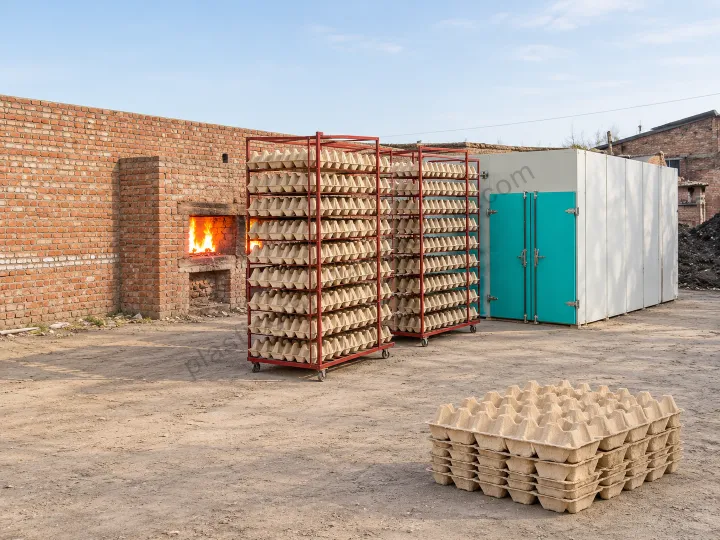
Between sun drying and continuous dryers sits a simple intermediate: an insulated chamber about 9 m × 2 m × 2.35 m holding ~20 trolleys of mesh racks, heated by a small 350,000 kcal gas or diesel burner. You load racks of wet trays, close the double doors, and dry a batch in a few hours. It is the natural upgrade for a sun-drying line that needs insurance against rain, at a fraction of the cost of a conveyor system — but because loading and unloading are manual, it does not remove the labor cost the way a true continuous egg tray drying system does.
3. Egg Tray Drying Temperature and Time: Why 180–200°C
Ask any experienced pulp molding engineer for a starting setpoint, and you will hear the same numbers: 180–200°C in the drying zone, with trays passing through in 20–40 minutes depending on capacity and tray thickness. Here is the logic behind those figures — and what goes wrong when you deviate from them.
Too cold (below ~150°C): drying time stretches out, throughput drops, and trays spend longer in the humid warm zone where mold spores activate. Slow-dried trays also tend to absorb more ambient moisture after leaving the dryer.
Too hot (above ~220°C) or too fast: the surface case-hardens while the inside is still wet. The hidden moisture later escapes, and the tray cups deform; over-baked trays become brittle and crack in the stacking test. High temperature without enough airflow just burns fuel for nothing.
Airflow matters as much as temperature. Every kilogram of water evaporated must be carried out of the egg tray drying machine — that is the job of the moisture-exhaust fan and the air-equalizing plates. A dryer with weak exhaust recirculates humid air, and you will see “dry outside, wet inside” trays even at correct temperature. This is why, when comparing quotes, the fan configuration and air distribution design tell you more about drying quality than the burner size does. Any supplier who quotes an egg tray drying system without specifying exhaust fan capacity and air-plate layout is quoting an incomplete machine.
Practical targets:
| Parameter | Recommended Range |
| Drying zone temperature | 180–200°C |
| Residence time (continuous dryers) | 20–40 min |
| Outlet tray moisture | ≤ 10–12% |
| Exhaust air | continuous, sized 1.5–3 kW minimum on mid-size lines |
| Final product check | trays stack 15–20 high without sag; no dark spots after 7-day storage |
4. Fuel Economics: Gas vs Diesel vs Coal/Wood
The burner is the running-cost heart of any machine-based paper dryer for egg trays. Choose fuel by three local factors: price per unit of heat, supply reliability, and emission rules.
- Natural gas is the default where piped gas exists: cleanest combustion, easiest burner automation, stable pressure. Most modern egg tray drying equipment ships with gas burners from 350,000 kcal (batch chamber) to 1,900,000 kcal (7,000 pcs/h line).
- Diesel matches gas in automation and needs no pipeline — the usual answer where gas is unavailable. Budget a slightly higher cost per kcal and on-site fuel storage.
- Coal or firewood is the cheapest heat where labor is cheap and emission rules are loose. It requires a grate furnace instead of a pressure-jet burner, more ash handling, and it is increasingly restricted near cities.
How to estimate your fuel bill. Evaporating the water from trays consumes roughly 1.2–1.5 million kcal of heat per hour on a 3,000–4,500 pcs/h line at full load. Multiply your local fuel price per million kcal by the effective running hours (say 20 h/day) and you have a defensible daily drying-cost figure to put in your business plan. A well-insulated metal-box dryer recirculates hot air and typically burns measurably less fuel per 1,000 trays than an uninsulated tunnel — insulation pays for itself.
Example: the ET-series paper tray dryers are configured with 0.9M–1.9M kcal burners that switch between natural gas and diesel, sized to each line’s capacity — contact us for configurations
5. Comparing the Three Egg Tray Drying Systems — and How to Choose
Put side by side, the three egg tray drying systems trade investment against throughput, consistency, and labor:
| Factor | Natural Sun Drying | Brick Kiln Dryer | Multi-Layer Metal Dryer |
| Drying time per batch | 1–3 days | 25–40 min (continuous) | 20–30 min (continuous) |
| Capacity match | up to ~2,500 pcs/h | 1,000–7,000 pcs/h | 1,500–7,000 pcs/h |
| Weather dependency | High — rain stops output | None | None |
| Drying uniformity | Low, operator-dependent | Medium–high | Highest |
| Equipment investment | None | Low (metal parts only) | Highest |
| Civil works | Yard paving | Tunnel construction by buyer | None beyond foundation |
| Floor area | 500–1,500 m² open yard | 40–75 m long workshop | 1,000 m² workshop, 6 m height |
| Dedicated labor | 2–4 workers | Minimal | 4–6 operators for whole line |
| Fuel | None | Gas / coal / wood | Gas / diesel |
| Best for | Start-ups, dry climates | Growing plants, cheap local construction | Export plants, consistent quality |
Decision tree — answer three questions:
- Can your product tolerate a rainy-week outage? If no (contract supply, export orders) → machine drying. If yes and land is cheap → start with sun drying.
- Can you manage local brick construction? If yes and budget is tight → kiln type. If you want the supplier to deliver a turnkey, insulated, plug-and-play line → metal box type.
- What is your forming capacity? Up to 1,500 pcs/h → sun drying or small chamber; 2,000–4,000 pcs/h → kiln or entry metal dryer; 4,500–7,000 pcs/h → multi-layer metal dryer sized to match (see next section).
In practice, the most common mistake we see is buying a large forming machine and under-buying the drying equipment. A well-matched egg tray drying system runs at the same rhythm as the forming machine, so wet trays never queue up between the two.
6. How Much Does an Egg Tray Drying System Cost?
Public price lists are rare because each system is configured to capacity, fuel, and voltage — but you can bracket the market like this:
- Sun drying: no drying equipment cost; budget for yard construction, racks/carts, and 2–4 additional workers.
- Batch chamber: lowest machine cost among dryers — a single insulated box plus trolleys.
- Kiln-type line: low equipment cost (belt, fans, burner, controls) plus locally managed civil construction, which varies widely by country.
- Multi-layer metal dryer: highest equipment cost, scaling with length, tray count, and burner size.
Seven variables that move the price: (1) line capacity and dryer length; (2) fuel type and burner brand; (3) voltage customization — lines are built to 380 V/50 Hz 3-phase as standard, and special-voltage versions carry a surcharge (typically USD 2,000–5,000); (4) number of trays and chain specification; (5) automation level of pulping and transfer; (6) packing volume — larger lines ship in 3–6 forty-foot high-cube containers, which affects freight; (7) installation and commissioning scope (remote guidance vs on-site engineer).
Want exact figures for your capacity and country? Request a quote — include your target output, available fuel, and workshop size for an accurate configuration.
Choose Your Drying Route
The right egg tray drying system is the one matched to your capacity, fuel, and site — not the biggest or the cheapest. Compare the three routes with real configurations:
- Starting small? Sun-drying production lines (ET-1-3 / 1-4 / 3-4 / 4-4) →
- Low-investment continuous drying? Brick kiln drying lines (ET-1-4 to 6-8) →
- Fully automatic, export-grade quality? Multi-layer metal dryers (ET-1500 to ET-7000) →
Or send us your capacity and workshop size, and we will recommend the configuration that fits.